Why Forward Abseiling Builds Real Courage And Why People Who Say “I Could Never” Need It Most
Some Careers Begin With a Handshake. Others Begin at the Edge of a Cliff.

TL:DR
Courage isn’t intellectual; it’s physical. In my first week of military training, we participated in an adventure week, including forward abseiling. Backwards (the regular way) is a lot easier than forwards; standing at the cliff’s edge is an extreme way to test your limits, build confidence and overcome fear. Your body and mind scream, “This is not normal. Don’t do this.” And that’s exactly why it’s so powerful. If you read this and think, “I could never forward abseil” then you could benefit the most and experience deep transformation.
🕰️ Read time: approx 9 mins
Hot tips for players

It’s unlikely that your job requires you to forward abseil, perhaps you could choose to undertake an adventure activity voluntarily!
You can do hard things (even if you don’t think you can)
What you struggle with becomes what strengthens you
The hardest moments are saying yes and standing on the cliff’s edge. Once overcome, the fun begins!
Self-belief shifts; fear is reframed as a teacher, not an enemy; and you don’t think you’re capable, but you experience being capable
Introduction
No, I wasn’t auditioning to be the next Tom Cruise.
There was no motorbike, ramp and special effects—just ropes, a cliff, and a moment that redefined courage.
This wasn’t Hollywood. Instead, an unnerving realisation that courage requires stepping into the impossible.
Careers usually start with a handshake, PowerPoint slides, a tour of the building, morning tea, information sessions and paperwork. These are designed to reduce friction, not reveal character.
The purpose of these activities are:
“Here’s how things work.”
My Royal Australian Air Force (RAAF) Officer training instead started with an adventure week in the very first week and began by asking:
“Who are you under pressure?”
The adventures included white water rafting, rock climbing, canyoning and abseiling.
White water rafting was okay as the water wasn’t too rough; no Zambezi River in Zimbabwe, luckily!
The rock climbing was only a short height, so it wasn’t too difficult.
Canyoning was confronting at times: cold, dark, and deep underground, moving through tight, confined spaces. We held the ankle of the person in front and slid forward, flat to the ground, crawling through complete darkness. I held on very tightly; I definitely did not want to be left behind deep in a dark cave.
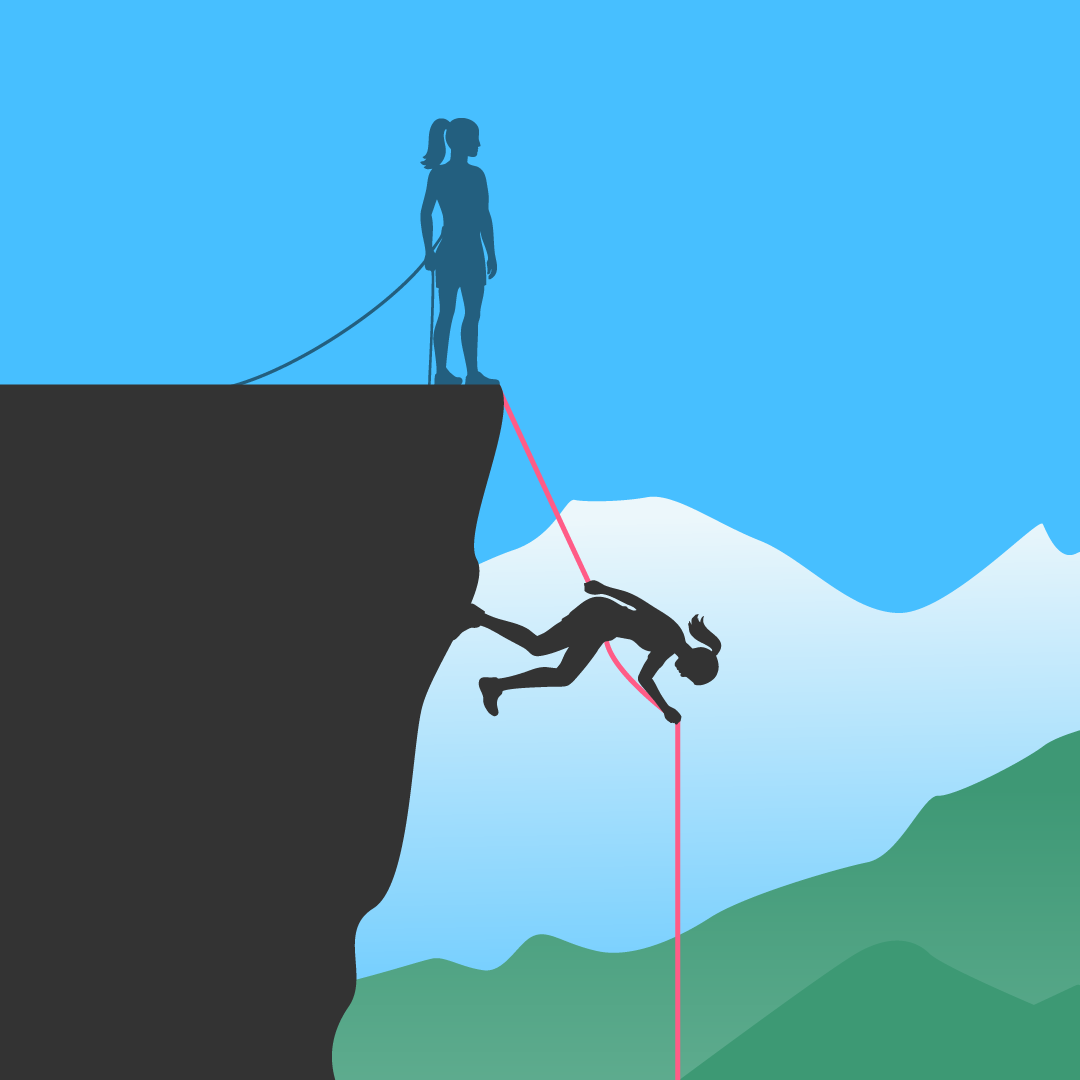
The activity that was the most challenging was abseiling forwards off a cliff. The designer who created the abseiling image at the top of this article wanted to confirm it was supposed to represent forwards, because really should it be?! I’d abseiled the common way (backwards) at age 12, down a very high and steep cliff face next to a waterfall. Beautiful and challenging at the same time.
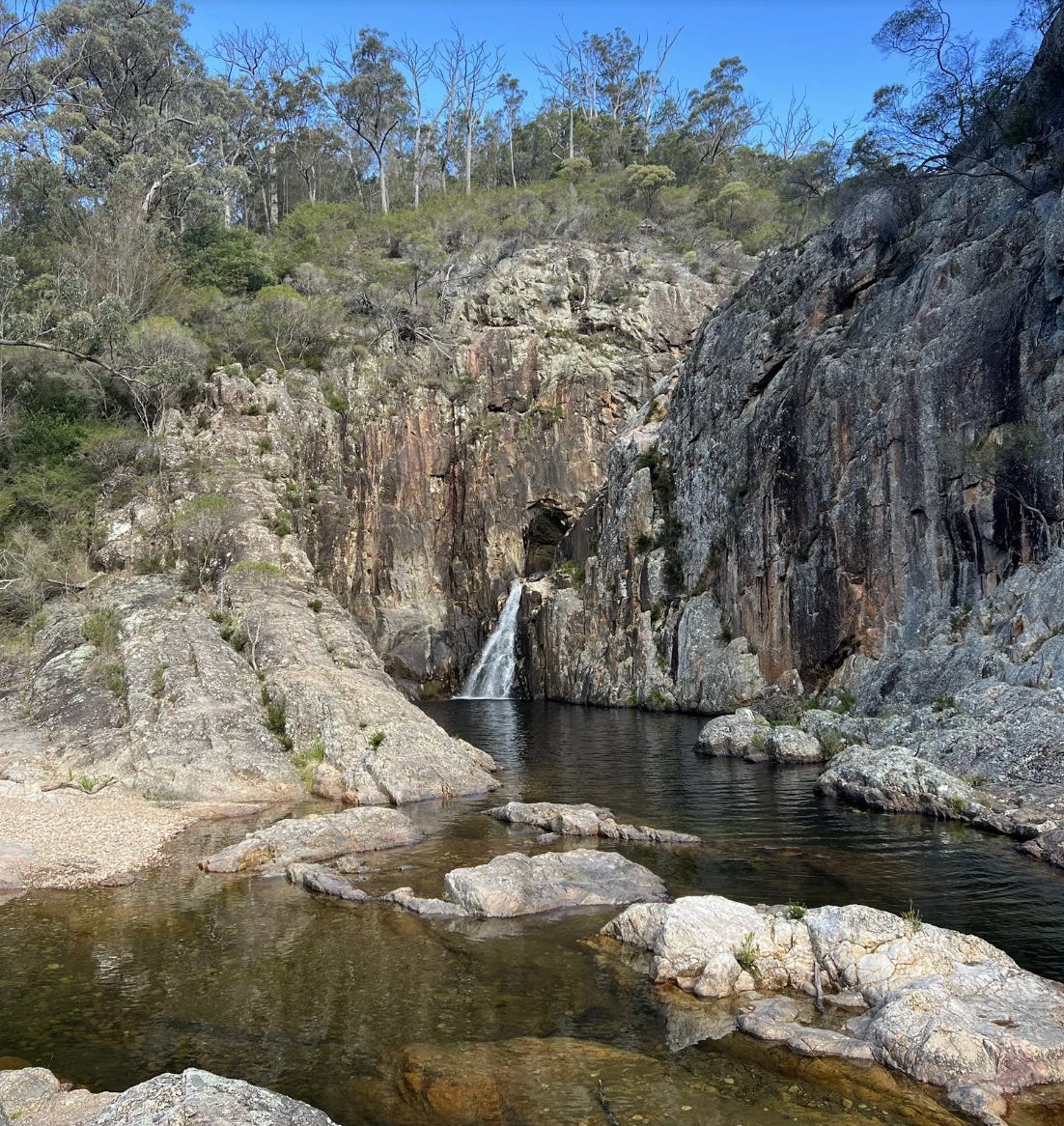
Scaling a cliff face backwards, whilst difficult, is a lot easier than going forward. As you slowly clamber down the cliff edge facing backwards, you look up and see the instructor, which is comforting, especially if something goes wrong. I did look down whilst abseiling that first time, but that was a choice. I mostly looked up at the instructor or at the cliff in front of me. I remember thinking that if I fell or the ropes malfunctioned, I would at least fall into the water and there was a chance of survival.
This time, there was no water, just hard, dry ground, no chance of survival…
The idea of forward abseiling was exciting because I’m an adrenaline junkie. Yet, at the same time, I was petrified. It’s strange to experience fear and excitement at the same time; emotions we often think of as opposites. It’s like watching a horror film. I love these films because of the adrenaline rush, at the same time, I’m often very scared.
I’m not one to just launch off a cliff. I like to ponder. Some people may say: ‘you just need go for it before you have time to think about it’, but that’s not how I approach challenges. I see the dangers pretty quickly. I would have to have all the gear fitted and step off that cliff in under 30 seconds to ‘not think about the risks’. I’d already very quickly realised the level of danger this activity involved.
The battle: excitement versus risk, thrill versus survival.
I knew it wasn’t mandatory to do this activity, but preferred, which basically means it’s best if you do it. If you don’t do it, the others would always know, and this is something that I didn’t want either. We had all only met each other earlier that week and would spend the next 11 weeks together and then work together in different ways throughout our military careers. This type of peer pressure was intentional as it works. Overcoming this challenge was an important part of the leadership training, which is why they set it as an activity in the first place. Bonding through shared vulnerability was another outcome.
One woman was crying on the ground, so I can see why they couldn’t just tell people they had to do it, especially for those who are terrified of heights. I knew it was best to take the leap, and the adrenaline junkie inside of me was ready, the practical side not so much.
So the first challenge was overcome: I said yes!
The cliff edge was the hardest part.
Similar to when you first jump out of a plane to skydive. That first step is the most difficult. Once you do that, there is no turning back; you’re falling through the sky or clambering down a cliff, and there is no option to return.
It all happened very fast, no time to stand there, which is probably a good thing. I knew that lingering would make everything harder, so I took a deep breathe and stepped forward and down. It also helped that I had all the gear on, the instructors were waiting and people were watching, it helped me to keep moving forward, even though a part of me wanted to move back! After I stepped over the edge, I felt a lot better as my feet hit the cliff face, a hard rock feels like sturdy ground. I slowly became used to the feeling and gained balance and confidence. I was extremely focused on each foot touching the cliff face and moving slowly to not lose my balance.
I was forced to look down. I couldn’t close my eyes as I had to step off the edge and descend carefully. If I didn’t control my movements, I could have slipped and become tangled. I definitely didn’t want to be dangling off a cliff face, trapped in a web of ropes. There was an instructor down on the ground below, but very far away, barely a figure in the distance.
After a few steps, I felt confident and looked around at the beautiful landscape, dense bushland. I realised that I was safe, the ropes held very tightly around my mid-section, I relaxed and started to have fun—I starting running down the cliff!
I remember thinking, “I’m getting paid to do this!”
I had a similar experience skydiving; once the parachute came out, I felt very relaxed, admiring the scenery (South Island, New Zealand), feeling the rush of excitement as I fell through the sky and knew that I was alive and could enjoy the moment.
Military Adventure Training
Military adventure training is not recreation. It is deliberate exposure; a controlled way to teach the body and mind how to function when comfort, certainty, and control are removed. It uses physically and psychologically demanding activities; to create stress with structure.
It answers one question first:
Can you function when your nervous system is loud?
These are not chosen for thrill. They are chosen because they reliably provoke:
Fear
Uncertainty
Loss of perceived control
Physical fatigue
All while remaining supervised and safe.
The core purpose
✔️ Stress inoculation
Exposing individuals to manageable stress so the nervous system learns:
Fear is survivable
Activation can be regulated
Performance does not require calm
This is foundational for military roles, where stress is unavoidable.
✔️ Embodied confidence
Confidence is not taught verbally.
Adventure training provides physical proof:
“I have felt fear and remained functional.”
That proof lodges in the body and becomes accessible.
✔️ Decision-making under pressure
Activities force participants to:
Act without full information
Make decisions while physiologically activated
Trust training, equipment, and judgement
This mirrors operational conditions more accurately than classroom learning.
✔️ Trust and reliance
Participants must:
Trust equipment they did not design
Trust instructors and teammates
Be trusted in return
This builds functional trust.
✔️ Revealing behaviour
Adventure training removes polish.
Under fatigue and fear, people reveal:
How they respond to authority
How they manage risk
Whether they freeze, rush, or stabilise
How they support or undermine others
This information is invaluable for leaders.
Fear is expected. Control is the metric.
Military adventure training teaches the lesson:
Courage is not the absence of fear.
It is behaviour that remains effective in its presence.
Step Over the Edge. Meet Your Strength
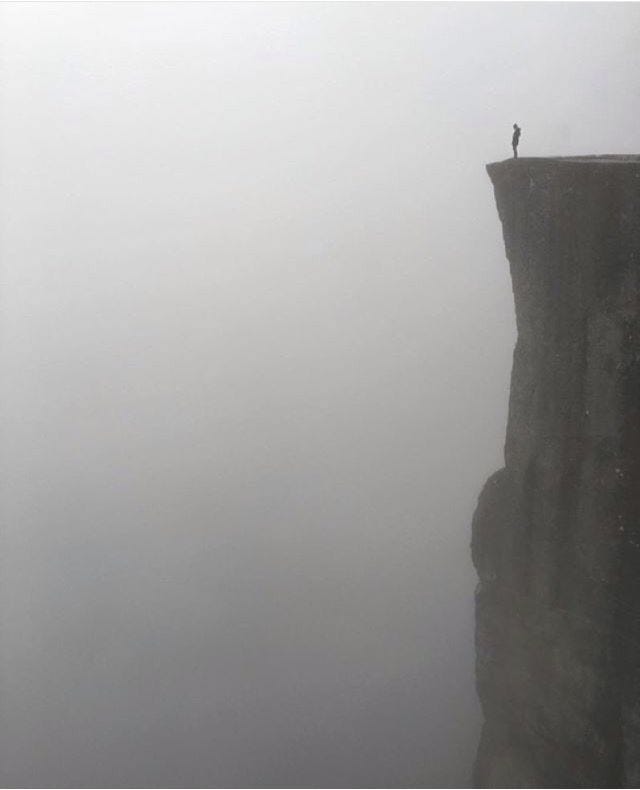
The moment your feet reach the cliff edge, something ancient wakes up inside. Every instinct in your body whispers the same warning:
“This is not normal. Don’t do this.” And that’s exactly why it’s powerful.
You feel fear rising, your heart pounding, your breath shortening. Then, despite every signal screaming no, you take a step forward into open air. You then realise that fear doesn’t own you. That you can do something that terrifies you and still stay in control.
Real courage isn’t something you think; it’s something you step into. Forward abseiling taught me that. One moment you’re on solid ground, and the next you’re leaning your entire body weight over an edge with your instincts saying you shouldn’t enter ‘the danger zone’!
Suddenly you realise: you’re capable of far more than your fear wants you to believe.
This is why activities like forward abseiling matter. Not because they’re extreme or impressive. Because they give you a moment where the truth becomes undeniable:
You are stronger, braver, and more capable than you’ve been led to believe, especially by the parts of yourself that still doubt it.
So why take this step over the edge/forward?
After achieving these types of activities, you always have the memories there to recall: “I’ve launched myself over a cliff edge/[insert activity here]” during challenging times. In my career and life, I encounter challenges, yet they aren’t at the level of forward abseiling. I can use this as a reminder of my capabilities and ability to overcome fear.
I tell myself:
I can do hard things
This phrase was popularised by Glennon Doyle in her 2020 bestselling book Untamed.
“What stands in the way becomes the way”. Marcus Aurelius
(Aurelius, ca. 180/2002, 5.20)
Marcus Aurelius, writing in Meditations, captured a fundamental Stoic truth: obstacles aren’t detours; they’re the path itself.
The thing that blocks you is the very thing that shapes you. What you struggle with becomes what strengthens you.
Benefits

I loved the TV show Who Dares Wins as a child. On the show, contestants competed in high-risk, physically and psychologically demanding challenges (including forward abseiling), often set in rugged Australian environments. As a family we would also discuss if we would say yes to the challenges they set. Interestingly, whilst this show was aired (1996-1998) is the same period when I first abseiled backwards. Watching everyday Australians complete these challenges on the show, likely influenced my belief that I could also achieve these.
Whilst I didn’t win cash or a holiday like on the show, there were many other benefits from my military challenge.
Here’s why an activity like forward abseiling is such a powerful “I can do hard things” moment:
◼️ You step over an edge you’re not “supposed” to go over
Everything in your biology says, “This is unsafe. Don’t lean forward off a cliff.”
Forward abseiling requires you to override instinct with trust: trust in the rope, equipment, instructor, body and judgement.
That leap, literal and psychological, is the moment self-belief starts to shift.
◼️ You feel fear and act anyway
The nervous system learns through experience.
When you feel your heart pounding from adrenaline and think and feel the “don’t do this” message, yet you still step forward, your mind receives a new message: “I survived doing something terrifying, maybe I can survive other things, too.”
That becomes an internal reference point you can draw on later.
◼️ It gives immediate, undeniable proof of capability
You don’t think you’re capable. You experience yourself being capable.
And the body remembers.
◼️ The challenge is structured, not chaotic
Forward abseiling is frightening, but it’s also controlled, supervised and safety-checked.
This creates the ideal environment for healthy, growth-building stress (eustress).
You’re safe and scared; that’s exactly where confidence grows.
◼️ It confronts the “I can’t” story directly
A lot of people carry hidden beliefs, such as “I can’t trust myself” or “I fall apart under pressure”.
Forward abseiling crushes these beliefs because the body contradicts them.
The story becomes “I’m stronger than I thought.”
◼️ You learn to take control of a situation that looks uncontrollable
As you descend, you stabilise, focus and gain confidence.
This builds an internal locus of control.
◼️ It reframes fear as a teacher, not an enemy
A powerful thing happens mid-descent:
The fear becomes focus.
You realise fear doesn’t have to stop you—it can sharpen you.
This becomes a psychological blueprint:
Fear doesn’t mean stop. It means pay attention.
◼️ It creates a new emotional identity
Afterwards, people often say:
“I didn’t think I could do that.”
“I didn’t know I had that in me.”
“I surprised myself.”
This is identity-level change.
You’re no longer the person who “can’t handle things.” And once the body learns its capability, it doesn’t forget.
Why “I Could Never” Is the Right Place to Start
Whilst your job may not require or pay for you to forward abseil off a cliff, perhaps it’s something you could do for yourself.
Any challenging activities will help you to achieve some of the same benefits. These could include:
Skydiving
Bungee jumping
High ropes course
Ziplining
Paragliding
If you read this list and start to become anxious, a little stressed, your palms become sweaty or you have thoughts of “I could never”, then you’d likely greatly benefit from the activity. That is exactly where the growth lies. “I could never” is the mind’s attempt to protect you. It’s the nervous system predicting danger, exposure, or loss of control.
The people who benefit most from these experiences are those who believe they can’t do them.
Courage is not a personality trait, it’s a skill developed under pressure. And the more you avoid fear, the louder fear becomes. The more you face it, the quieter it gets.
Conclusion
I’d skydived and abseiled backwards before this experience. So whilst this was challenging, the thought of “I could never” or feelings of intense distress didn’t happen, making it a little easier. I’d already had those thoughts and stated them many times out loud. I had even boldly declared “I will never skydive”! which I did two years before the forward abseiling challenge.
I benefited in many ways from the forward abseiling experience. Primarily as this was another activity to include on my list to prove my ability to overcome fear. My confidence and courage increased significantly.
Perhaps you could experience a similar or even deeper transformation if you start by saying “yes” to something you never thought you could do.
You can do hard things, and you’re stronger than you think.
Sources
Aurelius, M. (2002). Meditations (G. Hays, Trans.). Modern Library. (Original work published ca. 180).
Thanks for joining The Danger Zone—where life begins at the edge of comfort/the cliff edge!